
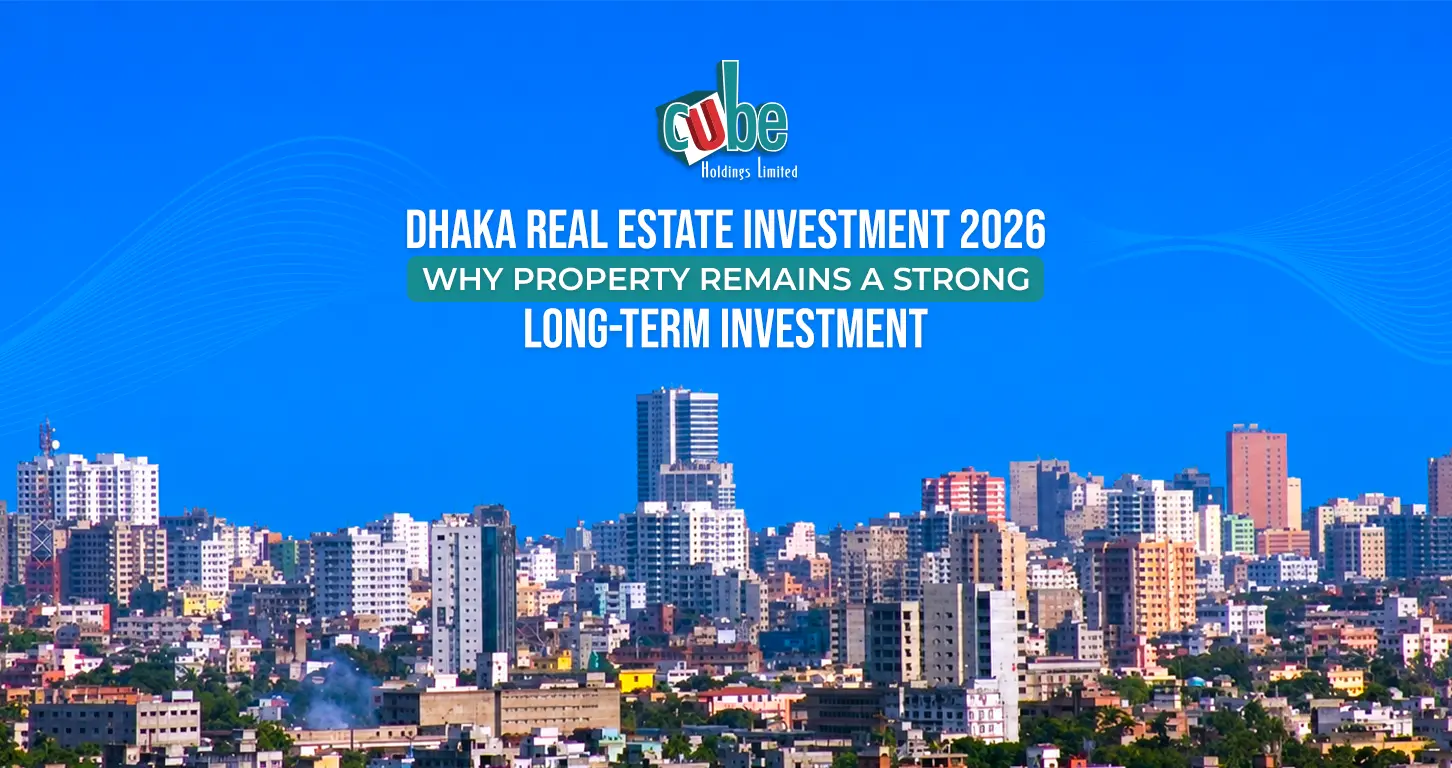
Dhaka Real Estate Investment 2026: Why Property Remains a Strong Long-Term Investment
Dhaka's property market has weathered inflation, interest rate hikes, and a slower sales cycle over the past two years, yet it continues to draw investors who value real estate investment for its durability compared with more volatile options.
This guide walks through the factors that shape real estate investment in Dhaka in 2026, compares real estate against other common asset classes, and outlines the checks every investor should run before signing a deed. So the decision rests on evidence rather than assumption.
Is real estate a good investment in Dhaka in 2026?
Real estate remains one of the more reliable long-term investment options in Dhaka, largely because the sector anchors a meaningful share of the national economy. Real estate and related activities contribute close to 7.9 percent of Bangladesh's GDP, according to Bangladesh Bureau of Statistics data, a scale that reflects steady demand even during slower sales years.
Inflation has stayed stubborn through early 2026, reaching 8.58 percent in January and averaging 8.66 percent over the trailing twelve months, which pushes many investors toward assets that hold value rather than cash sitting idle. Property in Dhaka has historically tracked or outpaced that kind of price pressure over multi-year periods, particularly in locations with improving infrastructure development.
Why is Dhaka real estate considered a long-term investment?
Property in Dhaka behaves like a long-term investment because the constraint driving its value, a shortage of developable land inside a rapidly growing capital, does not resolve itself within a single market cycle. Dhaka's population keeps expanding faster than its footprint, and that mismatch supports capital appreciation over extended holding periods even when short-term sales volumes soften.
Rental yield adds a second, steadier return on top of that appreciation, since an apartment in a strong location can generate income through multiple economic cycles rather than depending on a single sale event. Investors who plan to hold for five years or more tend to weather short-term volatility far better than those chasing quick resale gains, which is why holding period, more than timing, usually determines whether a purchase in Dhaka pays off.
What factors affect property value in Dhaka?
Several factors interact to set the value of a property in Dhaka, and understanding each one separately makes it easier to judge whether an asking price is fair.
Location and Connectivity
• Metro rail proximity: Areas near new metro stations have seen faster demand growth as commute times drop.
• Arterial road access: Properties close to major roads hold value better during traffic congestion spikes.
• Distance to commercial hubs: Units near Motijheel, Gulshan or Karwan Bazar typically command a premium over units further out.
Infrastructure and Utilities
Reliable gas, water, and electricity connections affect resale value nearly as much as location does, since buyers routinely discount properties in areas where utility supply is inconsistent.
Legal Status and Documentation
A property's legal standing sets a hard ceiling on its value regardless of how attractive the finishes are. Construction in Dhaka requires approval from RAJUK, the government authority responsible for regulating building and land use across the capital, and a project built without that approval carries real demolition and bank financing risks. Buyers who confirm RAJUK approval and a clean land title before purchase protect both their resale value and their ability to secure a mortgage later.
Which locations in Dhaka have strong investment potential?
Location remains the single largest driver of long-term value in Dhaka, and the strongest opportunities are currently split between established addresses and emerging ones.
Established Areas
Gulshan and Banani: Diplomatic and corporate presence keeps rental demand consistent.
Baridhara: A planned layout and proximity to international schools draw long-term residents.
Dhanmondi: Mature infrastructure and cultural amenities keep resale demand steady.
Emerging Areas
Bashundhara: Continued commercial expansion has pulled young professionals and families toward this area.
Purbachal: RAJUK's planned new city project has opened large tracts of land, with early buyers positioned to benefit most.
Uttara: Metro Rail access has shortened commute times to central Dhaka, which has directly lifted demand.
A closer comparison of these neighborhoods, including which ones suit different investment budgets, is covered in a dedicated breakdown of the best areas to buy an apartment in Dhaka for investment.
Is buying an apartment better than keeping money in other assets?
For investors focused on long-term value retention rather than short-term liquidity, an apartment in a strong Dhaka location generally outperforms cash sitting in a low-yield account, though it is not the better choice for every investor.
Comparing Common Investment Options in Bangladesh:
All-bank weighted average deposit rate stood at 6.16 per cent in June, while the lending rate was 11.86 per cent, which sounds competitive against real estate until inflation, averaging above 8 per cent over the same period, is subtracted, leaving a real return of only a percentage point or two on cash savings. Real estate does not offer that same liquidity, and selling a property quickly at full value is rarely possible, so investors who may need to access their capital within a year or two should weigh that constraint carefully.
What should investors check before buying property in Dhaka?
Legal Verification
Confirm RAJUK approval: Request the approved building plan and approval number directly from the developer.
Check the land title and mutation: Verify that the seller's name matches the current mutation record at the local land office.
Review the occupancy certificate: For a completed building, confirm the certificate was issued, since its absence often signals a departure from the approved plan.
Developer Track Record
A developer's history of delivering projects on schedule and to the specifications promised matters as much as the property itself, since a strong developer reduces the risk of delays, legal disputes, and quality shortfalls. Buyers should look for a documented history of completed projects, transparent pricing, and consistent communication, since these traits separate the best real estate company in Dhaka from newer or less established competitors. Cube Holdings, for example, has delivered residential and commercial projects across Dhaka since 2012, giving buyers a track record to review rather than a promise to take on faith.
What are the risks of real estate investment in Dhaka?
Every investment carries risk, and property in Dhaka is no exception. Construction delays remain the most common complaint among buyers of unfinished units, particularly when a developer takes on more projects than its capital and labor capacity can support. Legal disputes over land ownership still surface periodically, especially on plots with unclear mutation records, which is why the legal verification steps above matter. Market illiquidity is a real constraint too, since a property that needs to be sold quickly often has to be discounted. Oversupply in certain segments, particularly larger units outside the city center, has also kept some price growth flat in recent years.
How can investors choose a property with better resale potential?
Resale potential depends less on how a property looks today and more on whether the factors supporting its value will still hold in five or ten years. Location durability matters most, since an address near established infrastructure, schools, and commercial activity tends to stay desirable even as newer developments open elsewhere. Construction quality runs a close second, since buyers inspecting a resale unit will discount heavily for visible cracks or outdated fittings regardless of location.
Developers with a consistent record across multiple projects generally produce units that hold resale potential better over time, which is one reason luxury apartments in Dhaka from established developers tend to retain buyer interest even during slower market years. Reliable backup power, secure parking, and lift access round out the list of features that separate a property that sells quickly from one that lingers.
Final Thoughts
The strongest Dhaka property investments in 2026 tend to combine a defensible location, verified legal documentation, and a developer with a track record worth checking. Real estate will not suit every investor, particularly those who need quick access to their capital, but for those planning to hold for the medium to long term, property continues to offer a combination of appreciation and rental income that few other assets in Bangladesh can match consistently.
Frequently Asked Questions
Q: Is it better to buy a ready apartment or an under-construction property in Dhaka?
A: Ready apartments offer quicker possession and allow buyers to inspect the finished property, while under-construction properties may offer more flexible payment options and potential price appreciation before completion. The right choice depends on the buyer’s budget, timeline, and risk tolerance.
Q: How much money should I keep aside besides the apartment price?
A: Buyers should budget for costs beyond the advertised property price, including registration-related expenses, taxes or VAT where applicable, utility connections, parking, interior work, and ongoing maintenance. Calculating the total acquisition cost before booking can help avoid unexpected financial pressure.
Q: Can I buy an apartment in Dhaka with a home loan?
A: Yes, eligible buyers may finance an apartment through home loans from banks or financial institutions. Loan eligibility, financing limits, interest rates, and repayment terms vary by lender, income profile, and property documentation.
Q. What is the difference between carpet area and super built-up area?
A: Carpet area refers to the usable space inside the apartment, while built-up or super built-up area can include walls, balconies, and a share of common areas. Understanding these measurements helps buyers compare apartments more accurately.
Q: How can I estimate the rental income from an apartment in Dhaka?
A: Rental income can be estimated by comparing the expected annual rent with the total property investment and then accounting for expenses such as maintenance, service charges, taxes, and periods when the apartment may remain vacant. Rental demand can vary considerably by location and property type.
Q: What makes an apartment easier to sell in the future?
A: Resale potential is generally influenced by factors such as location, accessibility, apartment layout, construction quality, parking, building facilities, maintenance, and the reputation of the developer. Properties that remain attractive to both homeowners and tenants may have a broader future buyer pool.